
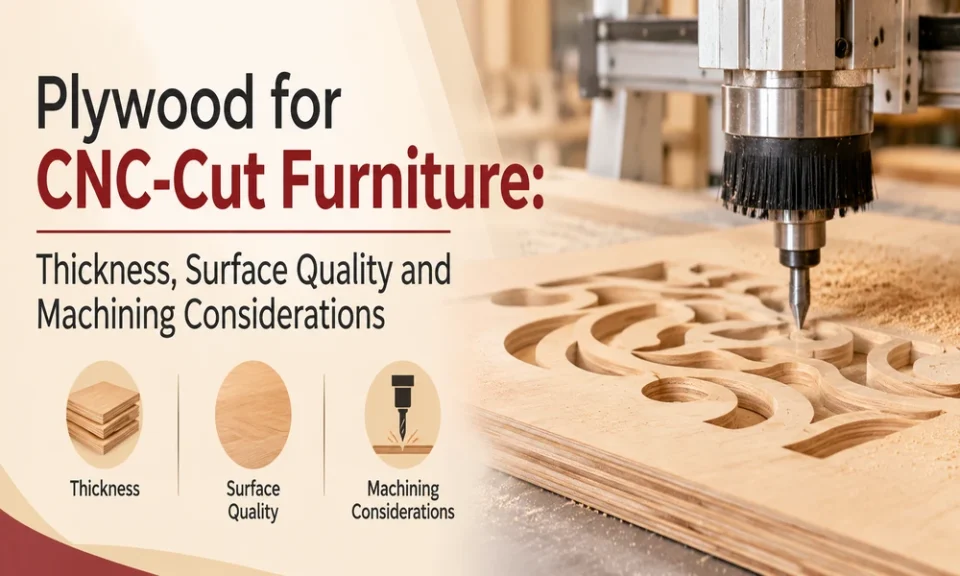
Nowadays, the furniture industry has been significantly changed due to CNC cutting as it allows the obtaining of various types of shapes and patterns in furniture design. It is widely used in the production of kitchens, wardrobes, partitions, and custom-made furniture,e as all the technologies applied in making various products require precision and exactness. The quality of the finished furniture product does not depend solely on the utilized machine since it directly relates to the plywood selection as well.
The selection of proper plywood for CNC-cut furniture involves defining several key points, such as the thickness of the sheets, the quality of the surface, and the internal structure of the plywood sheet, as well as mating requirements for the machine tool in use. By analyzing these issues, manufacturers and interior designers are able to achieve the best results in furniture production.
Importance of Plywood Selection for Cutting
CNC machines are programmed to cut plywood sheets into pre-defined shapes and patterns. The slightest variation in sheet thickness, presence of air cavities, or unequal gluing may affect the final result.
Therefore, plywood sheets should have a uniform structure, stable surface, and necessary strength. This would also minimize defects occurring during cutting and provide greater accuracy in assembly of parts.
In addition, manufacturing companies that process many parts must use premium-grade plywood sheets. The proper decision is dependent upon the function of the product, the dimensions of the item, and the concept of how it may be supported or assembled.
Plywood Thickness Considerations
Among the parameters regarding plywood thickness, the following should be taken into account:
- 6-9 mm: Appropriate for a number of lightweight sheets that will be used for ornamental purposes as well as for components that are not expected to bear a significant weight.
- 12 mm: Possible to apply for certain items such as cabinetry components and some other parts, depending on their design and support.
- 16-19 mm: A common thickness for what could be called solid panels, side elements of the cabinetry, as well as shelves that require a higher rigidity.
- 25 mm: Possible to implement for more massive items; however, if the design aspect permits.
These are common tips but are not to be seen as strict criteria. It is necessary to check the furniture project, what fixing method is welcomed, what span needs to be covered, as well as the CNC machine’s regulations for implementation of the size needed.
Surface Quality and Finishing Considerations
Materials that are to serve as hot laminates or veneers may require different surface preparation in comparison to those needing a paint finish.
When it comes to projects where the panels, doors, or furniture components will be exposed, plywood sheets for interiors need to be chosen considering their appearance as well as the finishing method. Even so, it does not mean that the face surface alone will ensure neat CNC machining.
Core Construction and Machining
Different types of plywood are produced by sticking together layers of wood veneer, and that consistency impacts the machining performance. The internals of the object,t like gaps, inconsistent bonding, or defects, can lead to rough edges, chipping, or weak areas.
Sample sheets must always be included in the testing process before any large-scale production. When samples are tested, the cutting tool, feed rate,e and cutting parameters should be accounted for. The edges, corners,s and cuts of the sheet must be assessed while especially paying attention to narrow or complicated designs.
In addition to using specified tools, the sharpness of the cutters has also to be taken into account, as well as the correct positioning of the sheet.
Waste Reduction and Efficient CNC Cutting
Efficiency starts with the testing of sheets in order to make sure they are correct. Make sure that its dimensions, thickness,s and state are monitored and correct cutting directions are followed. Position the sheet evenly and keep everything in mind when developing the design, e.g. the type of tools used, the amount of kerf, and the joining rules, etc.
Manufacturers producing wardrobes, cupboards, or any other kinds of bespoke furniture are going to be effective in the long term if they choose plywood for furniture making that is necessary for the job. Testing before cutting expensive sheets or large quantities of plywood is essential.
Conclusion
The process of choosing plywood for CNC-cut furniture is not limited to picking the right thickness. Surface quality, core consistency, and specific requirements for finishing are of vital importance. Hopefully, by testing materials and making sample cuts, furniture makers will be able to achieve good results with their products.
An example of such a plywood solution can be Royale Touche products presented in the framework of checking the right plywood specifications.
