
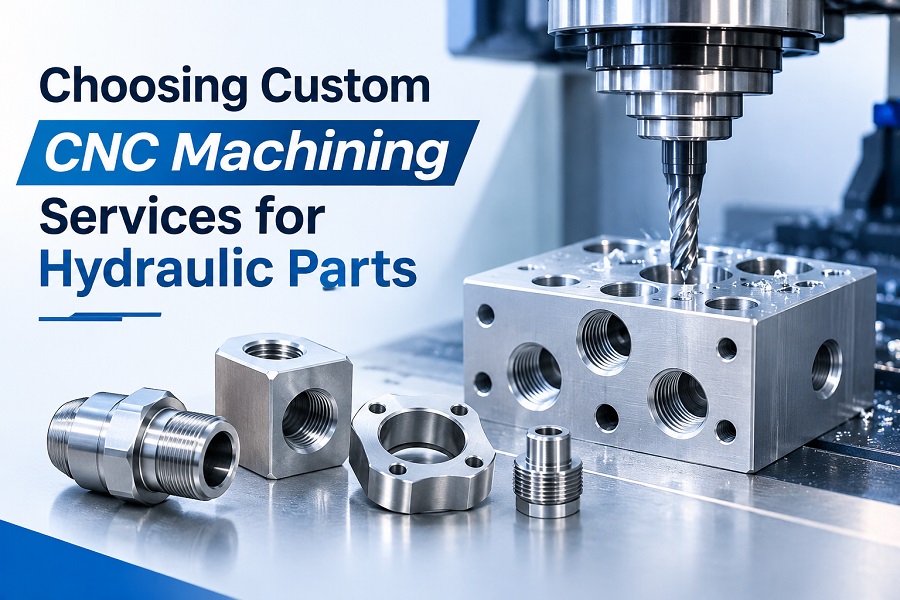
Selecting a machining supplier for hydraulic components is not simply about finding a factory that can produce parts to a drawing. For OEM manufacturers, even a small dimensional variation in a valve block, connector or forklift component can create assembly problems, oil leakage or premature equipment wear. These issues become more expensive when they affect an entire production batch.
Choosing the right custom CNC machining services requires a closer look at machining capability, material control, dimensional inspection and production consistency. But what should procurement managers actually evaluate before placing an order?
This guide explains the main technical considerations when sourcing precision-machined hydraulic components, including valve blocks, steel fittings and forklift mast parts. It also covers practical supplier questions that can help you reduce production risks and maintain consistent quality across repeat orders.
1. Understand the Machining Requirements of Your Hydraulic Components
Not every hydraulic component requires the same machining approach. A simple threaded connector has different manufacturing requirements from a multi-port hydraulic manifold block or a structural forklift component.
Before requesting quotations, identify the functional requirements of each part. Your supplier should understand how the component fits into the larger hydraulic or mechanical assembly.
Hydraulic valve blocks require precision in several areas
Hydraulic valve blocks contain internal passages, mounting surfaces, threaded ports and sealing interfaces. Their machining accuracy directly affects how components fit together and how hydraulic fluid moves through the system.
For example, a valve block may require:
- Precisely positioned mounting holes and threaded ports.
- Accurate bore diameters and depths.
- Flat sealing surfaces.
- Correct surface finish around O-ring grooves.
- Internal passages free from machining chips and burrs.
- Consistent port dimensions across production batches.
A machining error in one of these areas can cause assembly difficulties or leakage. Even when the external dimensions look correct, internal machining defects may remain unnoticed until the component is assembled or pressure-tested.
When sourcing custom hydraulic valve blocks, ask whether the manufacturer can handle drilling, milling, tapping, boring and internal passage cleaning within its production process.
Forklift components have different functional demands
Forklift mast components operate under repeated lifting loads, vibration and mechanical movement. Their dimensional requirements are therefore closely connected to alignment, fit and service life.
Components may include mounting brackets, precision pins, machined shafts, guide-related parts and other build-to-print items.
A supplier producing a forklift mast assembly or its associated components must understand the importance of consistent dimensions between mating parts.
A pin that is slightly oversized, for instance, may create installation difficulties. Excessive clearance can introduce unwanted movement, while poor surface finishing can accelerate wear.
The key is to machine each component according to its actual function rather than applying the same tolerances to every feature.
2. Select the Right Material and Machining Process
Material selection affects machining performance, component strength, corrosion resistance and final production cost.
A supplier should be able to work from your specified material grade rather than automatically substituting a more convenient alternative.
Common materials used in hydraulic and industrial components
The appropriate material depends on operating pressure, mechanical loading, environment and component design.
| Material | Typical applications | Important considerations |
| 45# steel | Shafts, pins and mechanical components | Strength, machinability and heat-treatment requirements |
| 20# steel | Selected tubes and machined steel components | Formability, welding and specified mechanical properties |
| Stainless steel | Corrosion-resistant fittings and connectors | Grade selection, corrosion environment and machining behaviour |
| Aluminium alloy | Lightweight valve housings and selected blocks | Strength, pressure suitability and thread durability |
| Alloy steel | High-load mechanical components | Hardness, heat treatment and dimensional stability |
These are general application examples, not interchangeable material recommendations. Always specify the exact grade, material standard and required mechanical properties in your drawing or purchase specification.
CNC milling versus CNC turning
Different machining processes suit different component geometries.
CNC milling is generally appropriate for valve blocks, mounting faces, slots, pockets and complex external profiles. CNC turning is better suited to cylindrical components such as pins, shafts, threaded connectors and precision sleeves.
Some components require both operations.
| Machining method | Best suited for | Main advantage |
| CNC milling | Valve blocks, mounting plates and complex profiles | Accurate multi-face machining |
| CNC turning | Shafts, pins, sleeves and fittings | Consistent cylindrical dimensions |
| Drilling and tapping | Hydraulic ports and mounting holes | Controlled hole and thread production |
| CNC boring | Precision bores and internal features | Accurate bore dimensions |
| Grinding | Selected shafts and precision surfaces | Improved dimensional control and surface finish |
A factory with multiple machining capabilities can reduce the need to transfer parts between different suppliers. However, one-stop production is useful only when the processes are properly controlled and inspected.
3. Evaluate Machining Tolerances and Inspection Capabilities
Dimensional accuracy is one of the most important factors when evaluating a machining supplier.
However, asking for a blanket tolerance of ±0.01 mm across an entire component is not always the best approach. Different features have different functional requirements, and unnecessarily tight tolerances can increase machining time, inspection costs and scrap rates.
Instead, identify the critical dimensions that affect assembly, sealing and performance.
Which dimensions deserve closer attention?
For hydraulic valve blocks, these typically include:
- Port centre-to-centre distances.
- Thread dimensions and thread depth.
- Bore diameters and positions.
- Mounting face flatness.
- O-ring groove dimensions.
- Surface finish on sealing interfaces.
For forklift-related components, pay particular attention to pin diameters, hole positions, shaft straightness, mating clearances and mounting dimensions.
As an example, a drawing might specify ±0.01 mm for a critical bore while allowing a wider tolerance on a non-functional external surface. These values should be determined by engineering requirements and confirmed through the manufacturing feasibility review.
Ask how dimensions are measured
A supplier should have suitable inspection equipment for the tolerances specified in your drawings.
Common inspection tools include:
- Coordinate Measuring Machines (CMMs) for complex geometry and positional measurements.
- Micrometers for precision external dimensions.
- Bore gauges for internal diameters.
- Vernier callipers for general measurements.
- Thread gauges for checking threaded features.
- Surface roughness testers for specified finishing requirements.
The equipment alone does not guarantee quality. You should also understand how inspection results are recorded and whether critical dimensions are checked during production or only at final inspection.
For repeat orders, request inspection reports that identify measured values against drawing requirements. This makes it easier to compare production batches and investigate dimensional variation.
Why first-article inspection matters
Before starting mass production, ask for a first-article inspection (FAI) of the initial manufactured component.
This gives your engineering team an opportunity to verify the part against the approved drawing before the factory proceeds with the full quantity.
It is particularly useful when introducing a new valve block design, changing material suppliers or modifying a forklift component.
4. Check Hydraulic Testing, Cleanliness and Quality Control
Machining accuracy is only one part of hydraulic component quality.
A valve block can meet its external dimensional requirements and still create problems if internal passages contain chips, burrs or contamination.
For this reason, procurement teams should evaluate the manufacturer’s cleaning, inspection and testing procedures alongside its machining capabilities.
Internal cleanliness should not be overlooked
During drilling, milling and tapping, small metal particles can remain inside hydraulic passages. If they enter the hydraulic circuit, they may damage pumps, valves and other sensitive components.
A suitable manufacturing process should define how internal passages are deburred, cleaned and inspected.
Depending on the component design, this may involve flushing, compressed-air cleaning, visual inspection and additional cleanliness verification.
Ask the supplier how it controls contamination before components are packed and dispatched.
Pressure testing and leakage inspection
Hydraulic components should be tested according to their intended application and approved technical requirements.
For example, a valve block may require pressure testing to identify leakage through ports, sealing interfaces or internal passages.
The test pressure, holding time, test medium and acceptance criteria must be agreed upon in advance. They should be based on the component specification and applicable design requirements, not selected arbitrarily by the supplier.
Relevant technical references include:
- ISO 4413:2010, which covers general rules and safety requirements for hydraulic fluid power systems and components.
- ISO 6162-1:2012, which specifies dimensions and requirements for certain hydraulic flange connections.
- ISO 6162-2:2018, which addresses specified 42 MPa flange connections.
These standards are relevant to hydraulic system design and connections, but the correct standard and edition should be confirmed against your actual component.
For hose assemblies, pressure testing and impulse life testing may also form part of the agreed quality plan. These tests serve different purposes: pressure testing checks specified pressure integrity, while impulse testing evaluates performance under repeated pressure cycles.
Quality management should be documented
An ISO 9001 quality management system provides a framework for controlling manufacturing processes, monitoring performance and managing corrective actions.
UBER Hydraulic identifies ISO 9001 certification among its company capabilities.
You can review the general requirements through the official ISO 9001 standard page.
For procurement buyers, the practical question is straightforward: can the supplier provide traceable inspection records, material documentation and evidence that non-conforming parts are identified and controlled?
5. Assess Production Capacity and Long-Term Supply Reliability
A supplier may produce an excellent sample but struggle when the order quantity increases.
This is a common concern for OEM manufacturers purchasing components for recurring equipment production. Your evaluation should therefore cover both technical capability and production planning.
A practical example: maintaining consistency across a bulk order
Consider a hypothetical forklift manufacturer sourcing precision-machined pins and mounting components for a new production programme.
The initial sample meets the drawing requirements. However, during a larger order, differences in tool wear, machine setup and inspection frequency could create dimensional variation between batches.
The solution is to establish a controlled production process before the order enters full production.
This may include:
- Approving the first production sample.
- Defining critical dimensions and inspection frequency.
- Establishing consistent machining setups.
- Monitoring tool wear and process variation.
- Recording inspection results for each agreed batch.
- Reviewing non-conforming parts before shipment.
[VERIFY WITH COMPANY: This is an illustrative manufacturing scenario, not a documented UBER Hydraulic customer case study.]
The lesson is that a reliable machining partner needs repeatable processes, not just capable machines.
Why integrated manufacturing can help
If your order includes machined components, hydraulic tubes, hose assemblies and fittings, coordinating several independent suppliers can increase purchasing and logistics work.
A manufacturer with multiple production facilities and complementary manufacturing processes may simplify sourcing, provided each process has clear quality responsibilities.
UBER Hydraulic presents itself as an OEM/ODM manufacturing supplier covering hydraulic hose assemblies, hard tubes, fittings, connectors, manifold blocks and CNC-machined parts. [VERIFY WITH COMPANY: Confirm current production scope and the four-factory statement.]
For international buyers, also check:
- Monthly production capacity for your part numbers.
- Standard and repeat-order lead times.
- Raw material sourcing arrangements.
- Packaging and corrosion protection.
- Export documentation capability.
- Procedures for handling urgent replacement orders.
- Production planning during peak demand.
Do not base your decision on the factory’s total machine count alone. Ask how much available capacity can actually be allocated to your order.
6. What to Ask Your Supplier Before Ordering
Before approving a new machining supplier, procurement and engineering teams should review the following points.
Supplier evaluation checklist:
- Can you manufacture the component directly from our 2D drawings and 3D CAD files?
- Which material grades and machining processes are available?
- Can you meet the specified dimensional and geometric tolerances?
- Do you provide first-article and batch inspection reports?
- Which measurement equipment is available for critical dimensions?
- How do you manage deburring and internal cleanliness?
- Can you perform pressure, leakage or impulse testing where required?
- What are your sample lead time and mass-production capacity?
- Can you maintain consistent specifications across repeat orders?
- What material traceability and quality documents accompany shipments?
Also clarify drawing revision control before production. A supplier should not manufacture from an outdated drawing simply because an earlier version was used for sampling.
For forklift-related products, consider applicable equipment safety requirements as well. The ANSI/ITSDF B56.1 standard addresses safety requirements for low-lift and high-lift industrial trucks. Component manufacturers should work to the relevant OEM engineering specifications and applicable safety requirements rather than assuming that a machining tolerance alone establishes component safety.
Frequently Asked Questions
1. What should I look for in a custom CNC machining supplier?
Look for relevant machining experience, suitable equipment, material control, dimensional inspection, documented quality procedures and the ability to maintain consistent production across repeat orders. Experience with hydraulic and industrial components is particularly useful.
2. What tolerances can CNC machining achieve?
CNC machining can achieve tight dimensional tolerances, but the achievable value depends on material, geometry, machine capability, workholding, process conditions and inspection method. A tolerance such as ±0.01 mm may be achievable on selected features, but should be confirmed during drawing review.
3. Can hydraulic valve blocks be manufactured from customer drawings?
Yes. OEM/ODM manufacturers can produce valve blocks from approved customer drawings and CAD models. The manufacturing review should cover material grade, port specifications, machining operations, sealing surfaces, internal cleanliness and inspection requirements before production begins.
4. Why should forklift component buyers request first-article inspection?
First-article inspection confirms that the initial manufactured part meets the approved drawing before larger quantities are produced. It helps identify dimensional or manufacturing issues early and reduces the risk of repeating those issues throughout a bulk order.
Conclusion
Choosing the right custom CNC machining services is a technical and commercial decision. For hydraulic valve blocks and forklift components, machining accuracy, material selection, cleanliness, inspection and repeatability all influence the performance of the finished product.
A supplier should be able to understand your drawings, identify critical dimensions and explain how quality is maintained throughout production. If you are sourcing precision hydraulic or forklift components, visit UBER Hydraulic’s website to discuss your requirements. You can share your drawings, material specifications and target quantities to request a manufacturing review and quotation.
