
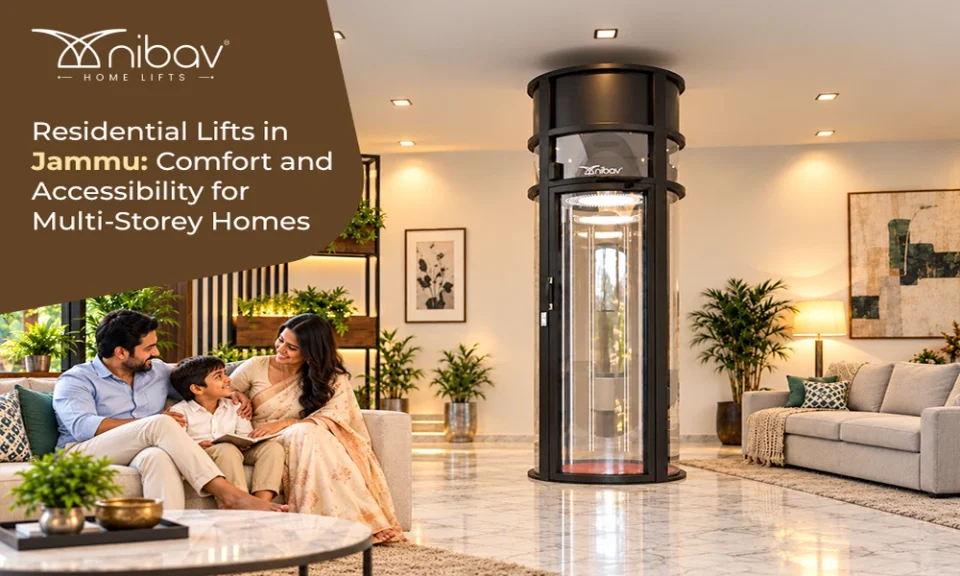
Homes in Jammu’s residential areas have been getting taller over the years. In Gandhi Nagar, Trikuta Nagar, Channi Himmat, Bakshi Nagar, Janipur and Sainik Colony, most family homes now have two or three floors. Usually, the parents live on the ground floor, the sons and their families live on the upper floors, and the terrace is used for drying clothes, sitting in the winter sun and spending summer evenings.
But not everyone in the family can reach every floor easily. For an elderly parent with weak knees, a family member who uses a wheelchair after a stroke, or a relative who cannot see well, the stairs can be a real problem. A residential lift can make every floor of the house easy and comfortable to reach for the whole family. This article explains what real accessibility means and how to plan for it in a Jammu home.
Why Accessibility Matters for Everyone at Home
Accessibility means everyone in the house can move around independently and safely, whatever their age or ability. It matters for:
- Elderly family members with arthritis, balance problems or heart conditions.
- People using wheelchairs or walkers, whether permanently or during recovery.
- People with low vision, who need clear, easy-to-find controls.
- Pregnant women and young parents carrying babies.
- Anyone recovering from surgery or injury.
A lift that is chosen with accessibility in mind serves all of them.
What are the specific design considerations for wheelchair access
If a family member uses a wheelchair or might in the future, plan carefully.
Cabin Size
The cabin must be large enough for the wheelchair and, ideally, a companion. Measure the wheelchair and compare it with the cabin’s internal dimensions.
Door Width
The lift door must be wide enough for the wheelchair to pass through easily, without scraping hands or the chair’s frame.
Landing Space
There should be enough space in front of the lift on each floor for the wheelchair to approach, turn and enter. A cramped landing can make an otherwise suitable lift difficult to use.
Level Entry
The cabin floor should line up closely with the landing floor, with no high threshold to roll over.
Reachable Controls
Buttons should be placed at a height a seated person can reach comfortably.
How does the Design Look Like for Low Vision and Other Needs?
- Large, high-contrast buttons that are easy to see.
- Tactile or Braille markings on buttons, where available.
- Audio or visual floor indicators, so users know where they are.
- Bright, even cabin lighting.
- Handrails for balance and support.
- A fold-down seat for those who tire easily.
Comfort in Jammu’s Climate
Hot Summers
Jammu summers are intense, with temperatures frequently crossing 40°C and sometimes approaching 45°C. A closed cabin can become uncomfortable. Ask suppliers about cabin ventilation and airflow, and consider placing the lift in a shaded, cooler part of the house.
Dust
Dry weather brings dust. Ask how the lift’s moving parts are protected and how often they need cleaning.
Monsoon Humidity
The monsoon brings humid conditions. Make sure the lift’s electrical components are protected from moisture.
Power Cuts
Storms can cause outages. Battery backup that brings the cabin safely to a floor is essential, particularly for wheelchair users, who cannot easily get out of a stalled lift.
A Checklist for Lift Planned to be installed in Jammu
Earthquake Safety
Jammu lies in a high seismic zone. A structural engineer should check any slab openings or structural changes, and lightweight, self-supporting lifts are a sensible choice.
Sloping Plots
Parts of Jammu, especially toward the Shivalik foothills, have sloping ground, and some homes have split levels. Make sure the lift can serve all levels, including half-levels.
Approvals
For new homes or major structural changes, check requirements with the Jammu Municipal Corporation or Jammu Development Authority.
Location
Good options include:
- Beside the staircase, if landing space allows wheelchair access.
- Near the main entrance, so users can go straight from the door or car to any floor.
- Close to the bedroom of the family member who needs it most.
How to Make the Whole Home Accessible
A lift works best as part of an accessible home:
- Ramps at the entrance, in place of steps.
- Wide doorways throughout the house.
- Accessible bathrooms with grab bars and roll-in showers.
- Non-slip flooring, especially near the lift and in wet areas.
- Good lighting in corridors and landings.
A Practical Example
Imagine a family living in a three-storey house in Trikuta Nagar. The father, a retired Army officer, suffered a stroke last year and now uses a wheelchair. His bedroom and the family’s living room are on the first floor, and the ground floor has a small office he still likes to use. Before the lift, moving him between floors needed two people and was risky for everyone.
The family worked with a supplier to choose a lift with a cabin large enough for his wheelchair and a family member, a wide door, level entry and controls he could reach while seated. They placed it near the entrance, where there was enough landing space, and added a ramp at the front door. The lift has good ventilation for summer and battery backup. The father now moves between his office, bedroom and the terrace on his own.
Conclusion
In Jammu’s multi-storey homes, a residential lift does more than save effort on stairs. Chosen with accessibility in mind, it lets every family member move around their home independently. Focus on cabin size, door width, landing space, level entry, reachable and clear controls and comfort in Jammu’s hot summers, and plan carefully for earthquake safety and power cuts.
If you are exploring options, Nibav Lifts offers residential lifts in Jammu designed for independent homes, and a site visit can help your family choose a model that meets your accessibility needs.
