
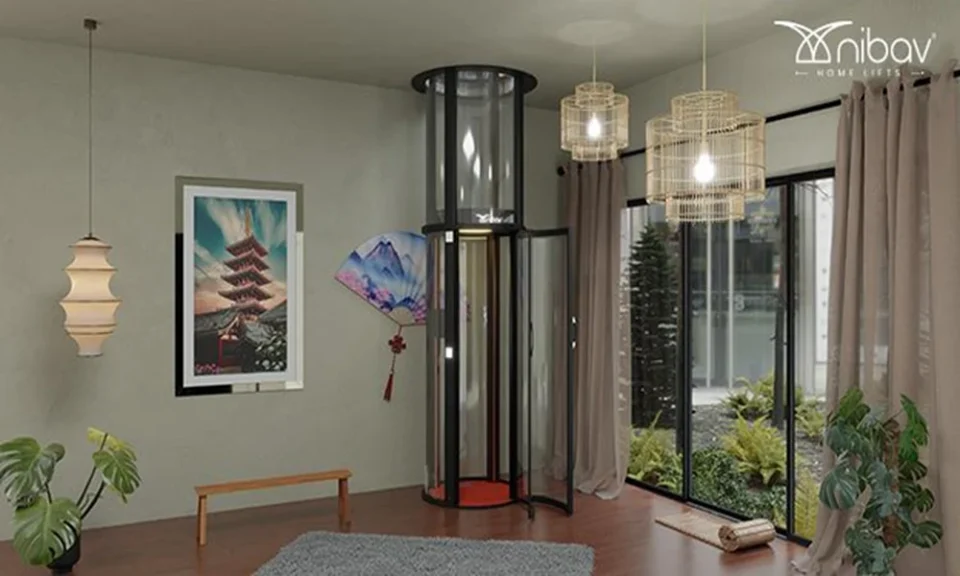
Introduction: A home lift can do more than move between floors
For years, a residential elevator was judged mainly by three things: how many people it could carry, how far it could travel and how much it cost. That is changing as homeowners become more comfortable with smart technology.
Today, the idea of a smart home elevator is about more than adding a touchscreen. Homeowners increasingly expect technology to make everyday movement simpler, more intuitive and more responsive. They want controls that are easy to understand, safety systems that work automatically and design features that feel integrated rather than added as an afterthought.
This is particularly relevant in modern Malaysian homes, where a lift may serve children, adults, older family members and guests. A smart home elevator needs to support different users without making everyday travel complicated.
AI-powered home elevators and other intelligent residential lifts are therefore best understood as multi-mode systems: they can combine intuitive controls, connected communication, safety monitoring and personalized interfaces with the core job of moving people between floors.
What makes a home elevator “smart”?
The term smart can mean different things. A homeowner should not assume that every smart feature is artificial intelligence.
A smart home elevator may include:
· App-based or remote controls
· Voice-command readiness
· Touchscreen interfaces
· Gesture controls
· Intelligent safety monitoring
· Overload alerts
· Emergency communication
· Automatic door sensing
· Personalized display themes
· Connected diagnostic or support functions
Some features are about convenience, while others are about safety. The strongest residential systems combine both.
For example, Nibav’s Series IV materials describe AI/voice readiness, gesture and app control. The Series V and V Max introduce VividTouch touchscreen control and SmartConnect for integrated emergency communication. These features show how a home elevator can combine multiple interaction modes rather than relying on one traditional control method.
The important question for buyers is not simply, “Does it have AI?” Instead ask, “Which smart functions will actually improve the way my family uses the lift?”
How multi-mode performance can improve everyday accessibility
Different people interact with technology differently. One family member may prefer a simple touchscreen. Another may appreciate voice control. A caregiver may value a wider doorway and clear controls more than an app.
This is why multi-mode performance matters.
Touch control can provide an easy visual interface for selecting floors and viewing system information.
Voice readiness can reduce the need to reach for controls, particularly when carrying items.
App or connected controls can provide an additional interaction method where supported by the model and system configuration.
Automatic safety monitoring works in the background, without requiring the user to remember every safety rule.
Emergency communication gives users a direct method of requesting assistance when required.
For older adults, accessibility is not just about the physical cabin. Clear controls, predictable operation and easy-to-understand interfaces can also influence confidence.
Malaysia’s ageing population makes this increasingly relevant. Monash University Malaysia has highlighted the importance of home modifications that support safer, more independent living for older adults. A smart home elevator can form part of a broader accessibility strategy when it is selected around the user’s actual needs.
Who is the target audience for smart home elevators?
Tech-forward homeowners are likely to appreciate voice, app, touchscreen and personalization features.
Multigenerational families can benefit from a system that offers straightforward controls and layered safety.
Luxury-home owners may want smart functionality without sacrificing interior aesthetics.
Homeowners renovating existing properties can look for smart technology in a compact lift rather than assuming advanced features require a large commercial-style elevator.
Caregivers and families supporting older residents may value accessible controls, reliable communication and emergency features alongside physical accessibility.
Nibav and AI-powered home elevators in Malaysia
Nibav’s Malaysia range combines air-driven vertical mobility with smart and design-focused features.
The Series IV Standard is positioned around intelligent design, with voice/app readiness, gesture/app control, a touchscreen interface, smart safety features and a panoramic cabin. Its self-supporting structure is designed without a traditional pit or machine room, and Nibav states that prepared-site installation typically takes 4 to 5 working days.
Series V takes the smart-home experience further. VividTouch provides a bright touchscreen interface with selectable themes and intuitive controls. SmartConnect integrates communication into the touchscreen, while AutoGlide uses sensors to respond to movement and obstacles. The model also includes Smart Overload Alert, emergency descent and other safety features.
Series V Max retains this technology while adding a larger, wheelchair-friendly layout and higher capacity. That makes it relevant to homeowners who want both smart functionality and more generous cabin space.
| Nibav smart feature | Residential use |
| Voice/app readiness | Adds alternative ways to control compatible systems |
| VividTouch | Provides clear touchscreen control and customizable themes |
| SmartConnect | Integrates emergency communication into the lift interface |
| AutoGlide | Uses sensors to support automatic door operation |
| Smart Overload Alert | Prevents operation above the rated weight limit |
| Child Switch | Helps restrict unintended or unauthorized use |
| Emergency systems | Adds support during power loss or unusual situations |
Choosing smart home elevators with technology that actually helps
Smart features should support the household rather than make the lift harder to use.
Start with the interface. Can every regular user understand the controls? If the lift will be used by an older family member, a caregiver or a child, simplicity matters.
Next, separate convenience from safety. Voice commands and customizable themes are convenient. Overload protection, door detection and emergency descent are safety functions. Both have value, but they solve different problems.
Then consider the home’s physical requirements. Nibav’s Series IV Standard has a 210 kg capacity and requires approximately 1000 mm of clear space. Series IV Max and Series V Max offer larger cabin dimensions and higher capacity, making them more appropriate when accessibility and space are priorities.
Finally, consider whether the smart technology is supported locally. A smart home elevator is a long-term home installation, so homeowners in Kuala Lumpur, Selangor, Johor, Penang and other Malaysian locations should consider installation, servicing and support alongside the feature list.
Frequently Asked Questions
1. What is an AI-powered home elevator?
An AI-powered or intelligent home elevator generally refers to a residential lift that incorporates smart controls, automation or connected functions. The exact capabilities vary by model, so buyers should check the manufacturer’s specification rather than assuming every lift has the same AI functions.
2. Are smart home elevators difficult for older people to use?
They do not have to be. Clear touchscreens, intuitive controls, voice readiness and automatic safety features can make operation simpler when the interface is designed around accessibility.
3. What smart features does Nibav offer in Malaysia?
Depending on the model, Nibav offers voice/app readiness, gesture control, VividTouch touchscreen control, SmartConnect emergency communication, AutoGlide sensor-assisted doors and Smart Overload Alert.
4. Do smart Nibav home lifts still need a pit or machine room?
Nibav’s Malaysia home lifts are designed as self-supporting systems that do not require a traditional pit or separate machine room.
5. Which Nibav model is best for a larger smart-home application?
Series V Max is positioned for larger homes and accessibility needs, with a larger cabin and higher capacity than the standard Series V. A site assessment should determine the most suitable configuration.
One useful way to evaluate smart technology is to imagine a normal week rather than a showroom demonstration. Think about who will use the lift in the morning, whether someone may enter carrying bags, whether an older family member needs a simple interface, and what happens during a power interruption. The best feature set is the one that solves these real situations.
Smart technology should also be future-ready. A home lift may be used for many years, so homeowners should ask whether the controls are intuitive, whether safety features operate automatically and whether local technicians can support the installed system. The goal is not to fill the cabin with technology; it is to make vertical mobility feel simpler.
For Malaysian homeowners, that balance between intelligence, accessibility, aesthetics and practical installation is what makes a smart residential lift genuinely useful.
In short, smart performance should be judged by usefulness, not novelty. If a feature makes the lift easier, safer or more accessible for the people who live in the home, it earns its place.
