
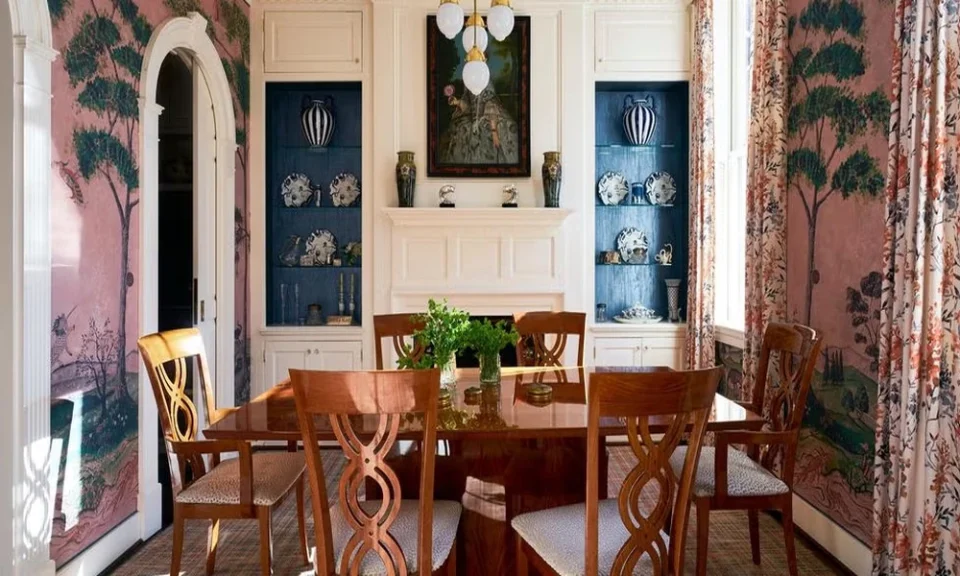
The dining room has a dual identity problem. For most households, it needs to function as a casual space where people eat breakfast, do homework, and pay bills – and then transform, several times a year, into the room where everyone’s best memories of a holiday happen. Designing for both without sacrificing either requires thinking about the room as a flexible system rather than a fixed arrangement.
Start With the Table
The table is the room’s anchor and the decision that constrains everything else. Getting it right for both everyday and holiday use is the central design challenge, and the answer for most homes involves some form of extension capability.
Extension tables – those with leaves that fold out or store underneath – have improved significantly in design quality over the years. Early versions were obvious compromises: the leaf mechanism was visually clunky, the extension didn’t match the table surface perfectly, and the whole arrangement felt temporary. Better contemporary designs integrate the extension mechanism invisibly, match finishes precisely, and add seating capacity without making the table look like it’s been assembled from mismatched parts.
The size question requires honest math. A table that seats six comfortably for everyday use is the right daily footprint for most dining rooms. A table that seats twelve for Thanksgiving needs to be significantly larger – and that larger size, in a room that’s typically proportioned for six, will make the space feel overwhelming for the other fifty weeks of the year. An extension table that seats six at its standard size and ten to twelve when fully extended solves this problem without requiring the room to live in holiday configuration year-round.
Shape matters for seating capacity. A rectangular table seats more people efficiently than a round one of comparable area. Round tables are socially preferable for smaller gatherings – everyone faces everyone – but reach their limits at six to eight people where rectangles continue to scale.
Seating That Does Double Duty
The chair situation for holiday gatherings is something most households handle the same way: drag in whatever’s available from other rooms and hope it works. A more intentional approach involves planning the seating system as part of the original design.
A bench along one side of the table – or along two sides of a rectangular table – seats more people per linear foot than individual chairs and stores more compactly when not in use. A bench that slides partially under the table when not needed takes up significantly less visual space than six chairs that have nowhere to go. Combined with upholstered host chairs at the ends, this arrangement looks intentional rather than improvised and scales more gracefully when additional seating is needed.
Stackable or folding chairs that are decent-looking rather than purely functional are worth the investment for households that entertain regularly. They live in a closet until needed and don’t force the room into holiday configuration prematurely.
Storage That Earns Its Square Footage
A buffet or sideboard earns its place in a dining room by solving two problems simultaneously: it provides surface area for serving during gatherings and storage for dining-specific items the rest of the time. Linens, serving pieces, candles, extra place settings – these things need to live somewhere, and a well-chosen piece of storage furniture keeps them accessible without requiring a trip to a different part of the house in the middle of a dinner party.
When evaluating storage furniture for a dining room, interior depth and shelf height are more important than they appear in photos. Serving pieces – large bowls, platters, tall candlesticks – have awkward dimensions that standard shelf spacing often doesn’t accommodate. Adjustable shelving, or enough vertical clearance to store oversized items, is worth checking before purchasing. Reading Coleman Furniture reviews for specific buffet and sideboard pieces often surfaces exactly this kind of practical feedback from buyers who’ve tried to fit their actual serving collections into the storage.
Lighting as the Room’s Most Flexible Element
Lighting does more work in a dining room than in almost any other space, and the combination of a dimmable overhead fixture with supplemental sources gives the room the range to feel casual at breakfast and dramatic at a holiday dinner.
A pendant or chandelier centered over the table at the right height – typically 30 to 36 inches above the table surface – anchors the room visually and provides direct light for the table. On a dimmer, it becomes the primary tool for shifting the room’s mood. Candles, whether on the table or on a sideboard, add warmth that electric light can’t replicate for special occasions.
The Details That Make Both Modes Work
A dining room that transitions well between everyday and special occasion use shares a few characteristics. The core furniture – table, chairs, storage – is quality enough to look right in both contexts without requiring a makeover for company. The textiles layer in easily: a simple everyday placemats situation becomes a full tablecloth and cloth napkin setup for the holidays without any permanent change to the room. The lighting is flexible enough to set different moods without swapping fixtures.
The goal is a room that’s always ready to be the everyday room and never more than twenty minutes from being the holiday one.
