
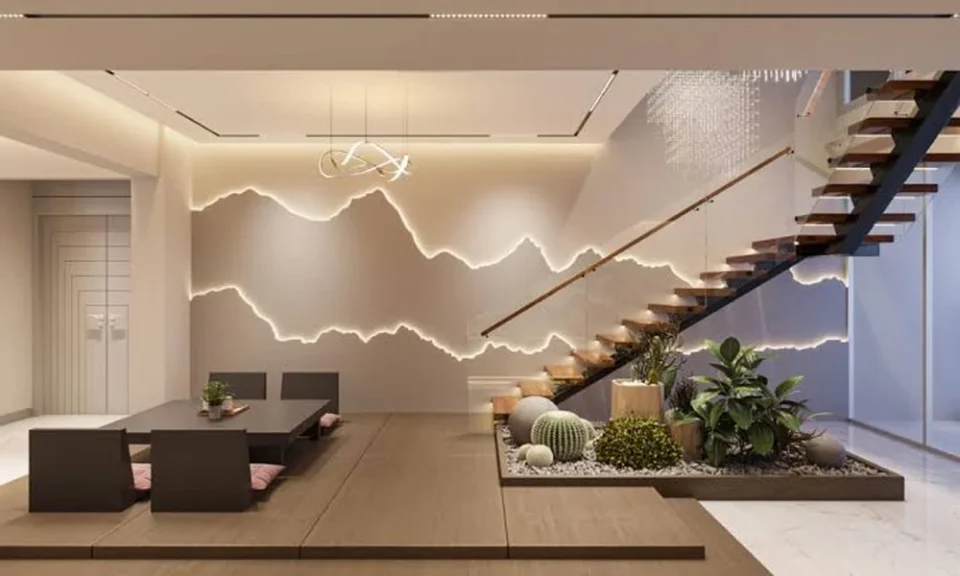
Modern homeowners have shifted from treating drywall installation as a generic cosmetic project, to looking at it as a preemptive structural engineering project that influences a wide spectrum of modern living. This shift recognizes a fundamental truth: luxury aesthetics are entirely dependent on structural physics. By prioritizing the engineering of the hidden substrate over final paint and lighting, this engineered approach prevents premature structural repairs and ensures the interior experience remains flawless for decades.
Drywall Texture as Controlled Atmosphere: Not Decoration, but Light Behavior
Texture is often misunderstood as styling. In reality, it’s physics applied to light. A perfectly flat wall doesn’t behave quietly, it reflects light aggressively. Every beam becomes sharp. Every angle becomes exposed. That’s why drywall texturing contractors: to control how light breaks apart when it hits a surface. By adjusting compound consistency, spray technique, and hand movement, these texturing specialists reshape the environment itself:
- Fine spray textures reduce glare in bright, open interiors
- Hand-applied finishes introduce depth without visual noise
- Controlled patterns soften reflections from LEDs and windows
But this is does not reward guesswork. It requires expert calibration. A master technician is constantly balancing air pressure (PSI), material flow rate, and nozzle orifice size against real-time room conditions like humidity and temperature. It’s a fluid dynamics problem disguised as finishing work.
When it’s off, the result is obvious; slump, streaks, or harsh shadowing. When it’s right, light no longer hits the wall. It spreads across it gently, almost invisibly. The room feels calmer without knowing why.
Strategic Density Selection of Drywall as a Safety Factor
Drywall isn’t just “sheet material.” It behaves differently depending on its internal structure, and that difference becomes critical once you move from standard interiors into regulated or high-risk environments. Standard gypsum boards and fire-rated assemblies like Type X are not interchangeable by default-they are selected based on performance requirements, not preference.
Type X drywall introduces a denser gypsum core reinforced with glass fibers and specialized additives that improve cohesion under heat exposure. This doesn’t make the wall “fireproof,” but it meaningfully extends the time before structural failure occurs during a fire event. In practical terms, it slows heat transfer, maintains integrity longer, and protects the framing system behind it during critical early stages of exposure.
Expert installation is never about blindly upgrading everything to Type X-it’s about context-driven material placement:
- Standard drywall for non-rated partitions and cosmetic walls
- Type X for garages, utility separations, stairwells, and fire-rated assemblies
- Layered systems combining insulation and framing for higher acoustic or fire performance
When correctly balanced, safety, cost, and performance align without overengineering.
That hidden engineering shows up subtly: better acoustic control, stronger spatial definition, and a more grounded feel when moving through a space. In restoration work, misalignment between material and environment is immediately visible-either through unnecessary rigidity or premature failure. Skilled contractors calibrate, not default.
Drywall Surface Porosity Control: Equalizing Surface Porosity for Consistent Results
When it comes to drywall, a perfect paint isn’t just about paint. A wall can look smooth and still behave unpredictably. That’s because drywall surfaces are not uniform. The paper face absorbs paint differently than joint compound seams.
So when light hits the wall, especially in modern interiors with strong daylight or LED systems, you don’t just see color. You see differences in absorption. That’s where experienced drywall finishers take control. Instead of treating the wall as “done after taping,” they reset its entire surface behavior:
- Full-surface skim coats unify absorption across the entire plane
- Paper face and joint compound are brought to the same response rate
- Subtle shadowing and seam outlines disappear under directional light
When this is done properly, paint stops behaving like a reveal layer. It becomes neutral. Dark tones don’t flash or show roller paths. Satin finishes don’t shift in patches. Even bold colors sit evenly across the room. The wall stops telling you how it was built.
Seam Integration: The Core to Integrating Panels to a Single Seam
Turning separate boards into one continuous space looks obvious until it fails. And when it fails, the results are obviously slightly unwelcoming. Every drywall wall is technically made of pieces. That’s the reality, sheets joined together, line after line. The goal of expert installation is not to hide that fact, but to make it irrelevant.
Buildings move. They settle. They respond to temperature, humidity, and seasonal change. If seams aren’t designed for that movement, they eventually announce themselves; usually as cracks or faint ridges cutting through expensive finishes.
So specialists don’t just “fill joints.” They engineer them. Drywall installation experts undertake taping, mudding, and feathering with precision to achieve a seamless surface while concealing hardware and preventing cosmetic flaws from showing
Other structural joint reinforcement protocols for seam stabilization may include:
- High-strength tape systems embedded deep into compound layers
- Staggered application passes to distribute stress evenly
- Framing alignment that prevents pressure from concentrating at seams
When done correctly, the wall stops feeling modular. It becomes one continuous surface that supports long sightlines, open layouts, and architectural flow without interruption. That’s where visual calm actually comes from.
Moisture Reality: Where Drywall Either Holds or Breaks Down
Drywall behaves beautifully in stable interiors, but it has a hard limit when moisture enters the system. In basements or humidity-prone environments, water doesn’t stay visible. It moves through concrete, travels upward through capillary action, and collects behind finished walls where it goes unnoticed until damage appears. That’s where restoration becomes engineering instead of installation.
Professional drywallers rebuild the wall system around moisture behavior:
- Moisture-resistant or fiberglass-faced boards replace paper-faced sheets
- Vapor barriers regulate how moisture migrates behind walls
- Rigid insulation controls temperature-driven condensation cycles
A precise half-inch mechanical gap at the floor breaks the capillary pathway, stopping slab moisture from ever wicking into the drywall system. The goal isn’t resistance, it’s directional. Moisture is not fought blindly; it is guided and controlled so it never destabilizes the finish.
Finish Calibration: Where Walls Stop Showing Work and Start Showing Design
Finishing is where everything either disappears, or becomes permanently visible. Modern interiors are extremely unforgiving. Grazing daylight, long LED strips, and minimalist design expose every imperfection. A slight ridge or uneven sand line doesn’t stay hidden-it becomes part of the room’s identity.
That’s why high-end finishing is really about one thing: visual neutrality.
- Seam invisibility under directional lighting
- Consistent reflection across large wall spans
- Long-term stability of surface appearance
The best walls don’t compete with design. They don’t demand attention. They simply hold the environment together so everything else can stand forward.
In essence, luxury interiors are never defined by what stands out. They’re defined by what doesn’t fail underneath with time. Drywall, when engineered with precision and installed with discipline, becomes the invisible system holding the entire experience together. It doesn’t compete with design, it makes design stable enough to exist at its highest level. However, the key to achieving incredible results and at a friendly budget is partnering with a drywall installation and repair expert that understands all types of drywall issues, from minor dings to large holes.