
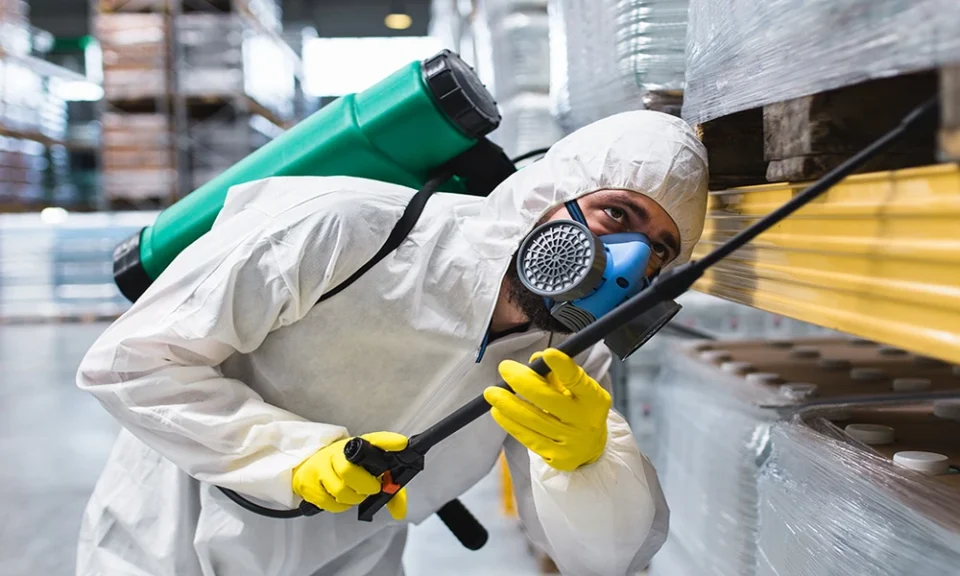
Homeowners who call Main Sail Pest Control about mounds in the lawn or holes along a slope are usually surprised to learn that the approach has almost nothing in common with a roof rat job. Rats get solved by sealing a building. Gophers and ground squirrels live in the soil, outside the structure, on land you cannot seal. Treating them like rats is the single most common reason people spend a season fighting the same burrow.
How do I tell a pocket gopher from a ground squirrel or a vole?
Look at the hole, not the animal. Pocket gophers push soil into a fan-shaped or crescent mound with the opening plugged and set off to one side, so you rarely see an open entrance. California ground squirrels leave open holes roughly two to four inches across with little or no mound, and they are active above ground in daylight. Voles cut narrow surface runways through groundcover and leave clean, golf-ball-sized openings with no soil pile at all.
Botta’s pocket gopher is the species doing the damage in Riverside County. It is solitary, so a single animal can produce dozens of mounds across a yard and give the impression of an infestation. The California ground squirrel is the opposite: it is colonial, and one burrow system can hold several generations with multiple entrances spread across a slope.
That distinction matters because it changes the count. Clearing one gopher can end the problem on a quarter-acre lot. Clearing three ground squirrels out of a colony of twenty accomplishes very little.
Why doesn’t exclusion work the way it does for roof rats?
Roof rat control rests on exclusion, which means physically closing off entry points, since a rat only needs a gap about half an inch wide to get into an attic. Seal the roofline, the plumbing penetrations, and the attic vents, and the population loses access to the structure.
There is no equivalent barrier for a burrowing animal in open ground. Gophers tunnel six to twelve inches below the surface, and ground squirrel burrows commonly run several feet deep and many feet long. A fence does nothing. The only exclusion that has real value is installed before or during planting: galvanized hardware cloth wire baskets around the root balls of new trees, buried mesh under raised beds, and wire sleeves on the base of young ornamentals. Once a landscape is mature, exclusion becomes a repair strategy rather than a control strategy.
What actually damages a Lake Elsinore property?
The visible turf damage is the least expensive part.
- Chewed drip and PVC irrigation lines, which often show up first as a wet spot or a zone that will not hold pressure
- Girdled young citrus and ornamental trees, where gophers strip bark below grade and the tree declines over months
- Tunneling and voids behind retaining walls and under hardscape, a real issue on the newer hillside tracts where engineered slopes depend on intact soil
- Erosion channels after the first heavy rain, when water follows abandoned burrow runs
Ground squirrels add a health dimension. The California Department of Public Health monitors ground squirrels and their fleas as plague hosts in the state, which is one reason the recommended practice is to treat the fleas in and around burrows before removing the animals rather than after.
When is the best time of year to treat gophers and ground squirrels?
Gophers can be worked year-round in this climate, and activity is easiest to read in spring and fall when soil is workable and fresh mounds appear within a day or two of disturbance. Ground squirrels follow a much narrower window.
University of California IPM guidance points to late spring through early summer, after the young have emerged above ground and before adults enter summer dormancy, as the most productive period for ground squirrel control. Bait acceptance improves once green forage dries out and squirrels shift to seeds. Burrow fumigation works best in spring while soil moisture is high enough to hold the gas, and it is largely wasted in mid-summer when animals plug their tunnels and become inactive.
Miss that window and you are usually looking at fall monitoring and a spring program, which is worth knowing before you sign up for a service expecting results in August.
Why does California law limit which baits a technician can use?
California has narrowed rodenticide use significantly. Assembly Bill 1788, the California Ecosystems Protection Act, restricted second-generation anticoagulant rodenticides statewide, and AB 1322 later extended a moratorium to first-generation anticoagulants, with limited exemptions. Both are administered through the California Department of Pesticide Regulation.
The practical result is that lawful landscape vertebrate work in Riverside County leans on trapping, burrow fumigation with registered products, non-anticoagulant baits where labeled, and habitat modification. Anyone promising a quick bait-only fix for a hillside squirrel colony is either working outside the label or working outside the law.
What a realistic program looks like
Expect an initial survey that maps active versus abandoned burrows, then a treatment sequence rather than a single visit. Gopher trapping typically involves locating the main runway, not the lateral that produced the mound, and setting paired traps in it. Ground squirrel work is measured over several weeks with follow-up on reopened burrows, because neighboring properties and adjacent open space keep supplying new animals. Ongoing monitoring, backfilling and tamping old runs, and cutting weedy cover along fence lines and slope edges is what keeps a cleared property clear.
If mounds, open burrows, or unexplained irrigation leaks are showing up in your yard, a proper burrow survey is the starting point. The team at Main Sail Pest Control handles landscape vertebrate work across Lake Elsinore and southwest Riverside County, and can tell you which animal you have, whether the season favors treatment now, and what it will take to protect your irrigation, trees, and slopes before the rains arrive.